Introduction
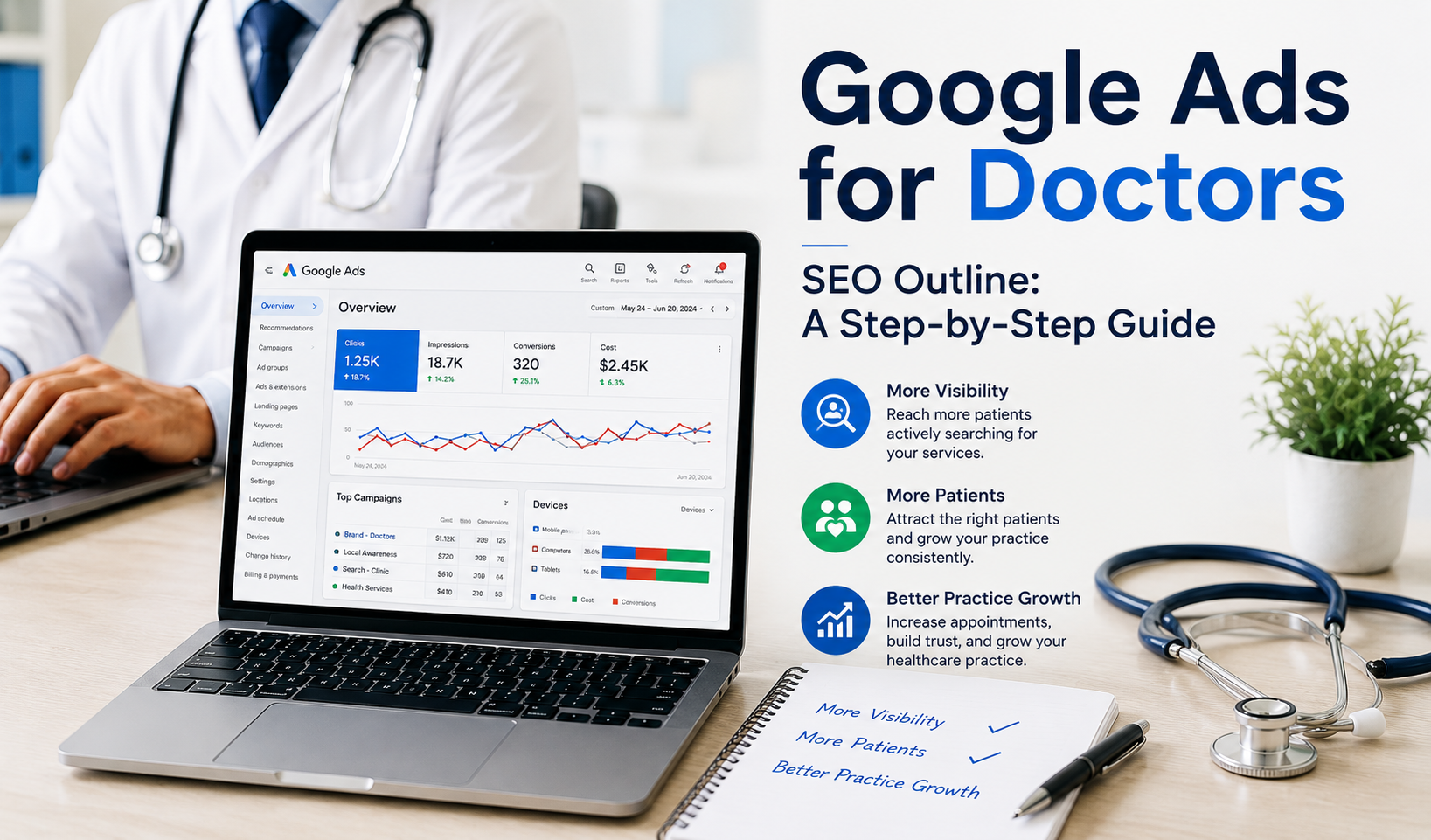
Running a medical practice in a competitive market means patients must find you before they find anyone else. A well-structured Google Ads for doctors SEO outline is no longer optional — it is the backbone of a sustainable patient acquisition strategy. Whether you are a GP, specialist, or allied health provider, combining paid advertising with organic search optimisation gives your clinic maximum visibility at every stage of the patient journey.
This step-by-step guide walks you through the exact framework used by high-performing Australian medical practices. By the end, you will understand how to build, optimize, and scale google ads for doctors campaigns that rank, convert, and deliver measurable ROI — while meeting healthcare advertising compliance standards.
Why Doctors Need a Dedicated Google Ads SEO Outline
The healthcare sector is one of the most competitive verticals in paid search. Patients searching for a “bulk billing GP near me” or “orthopaedic surgeon Sydney” see a SERP dominated by ads, map packs, and authoritative directory listings. Without a structured Google Ads for doctors SEO outline, your budget leaks into irrelevant clicks and your organic pages sit on page three.
- Patients make high-intent, time-sensitive searches — they need you now, not later.
- Google Ads and SEO reinforce each other: paid data informs organic keyword strategy.
- AHPRA and Google’s healthcare advertising policies require careful compliance — a structured outline prevents costly disapprovals.
- A unified outline ensures your Quality Score, Ad Rank, and landing page experience all pull in the same direction.
Step 1 — Keyword Research Aligned to Patient Search Intent
Every winning Google Ads for doctors campaign begins with search intent mapping. Patients search differently depending on where they are in their decision-making process. Segment keywords into three layers:
Awareness Keywords
These are informational queries: “how to find a GP”, “what does a dermatologist treat”. Target these with SEO-focused blog content and Display remarketing campaigns.
Consideration Keywords
Mid-funnel terms such as “best cardiologist Brisbane” or “affordable skin clinic Melbourne”. Use broad match with smart bidding, and support with organic landing pages targeting local search.
Decision / Transactional Keywords
High-intent phrases: “book GP appointment online”, “bulk billing doctor near me”. These are your primary ad group targets. Exact match and phrase match control spend while maximising conversion volume.
Pro tip: Export your search term reports monthly and feed converting terms directly into your SEO content calendar. This is the core mechanic behind maximising google ads for doctors SEO optimisation strategies.
Step 2 — Campaign Architecture That Supports Both Ads and SEO
A clean campaign structure is essential for both algorithmic performance and SEO alignment. Structure your google ads for doctors account using the Single Theme Ad Group (STAG) model:
- Campaign level: Separate campaigns by service (e.g. General Practice | Dermatology | Physiotherapy).
- Ad group level: One core theme per group (e.g. “bulk billing GP” vs. “GP after hours”).
- Landing page level: Each ad group maps to a dedicated, keyword-rich landing page — this directly improves Quality Score and organic ranking signals simultaneously.
- Negative keyword list: Build a shared negative keyword list from day one. Block “free”, “jobs”, “salary”, “training” and other non-patient terms.
Step 3 — Writing High-Converting, Compliant Ad Copy
Ad copy for medical practices must balance persuasion with regulatory compliance. AHPRA prohibits testimonials and comparative claims. Google restricts certain healthcare categories. Here is a proven framework for AHPRA-safe, high-CTR ad copy:
- Headline 1: Lead with the service + location (e.g. “GP Appointments Bondi — Book Today”).
- Headline 2: Address a patient pain point (e.g. “Same-Day Appointments Available”).
- Headline 3: Trust signal (e.g. “RACGP Accredited Practice | Bulk Billing Available”).
- Description 1: Expand on services and convenience (hours, parking, online bookings).
- Description 2: Clear call-to-action aligned to the landing page CTA.
Step 4 — SEO-Optimised Landing Pages for Google Ads Traffic
Your landing page is where your Google Ads for doctors SEO outline either wins or loses. A page optimised for both paid traffic and organic ranking must include:
- Primary keyword in H1, URL slug, meta title, and first 100 words.
- Page load speed under 2.5 seconds (Core Web Vitals — critical for both Quality Score and organic rankings).
- Schema markup: MedicalClinic, Physician, and LocalBusiness structured data.
- Mobile-first design with click-to-call and online booking buttons above the fold.
- E-E-A-T signals: doctor bios, credentials, clinic accreditation, and patient education content.
- Internal linking to related service pages and blog articles — strengthens topical authority for SEO.
Step 5 — Google Ads Optimisation for Doctors: Top 10 SERP Analysis
Before launching or improving any campaign, conduct a thorough google ads optimisation for doctors top 10 SERP analysis. This means manually reviewing the top 10 results for every core keyword and documenting:
Completing this analysis before every campaign refresh ensures your google ads for doctors strategy is data-driven and not based on assumptions.
Step 6 — Maximize Google Ads for Doctors SEO Optimisation Strategies
To truly maximize Google Ads for doctors SEO optimisation strategies, paid and organic must operate as a single integrated system. Here are the advanced tactics that separate top-performing medical practices from the rest:
1. Conversion Tracking and Call Tracking
Install Google Ads conversion tracking for every booking action: form submissions, phone calls, and online appointment completions. Feed this data back into Smart Bidding algorithms (Target CPA or Target ROAS) to let Google automatically shift budget towards your highest-converting keyword themes.
2. Remarketing for Patient Re-Engagement
A significant portion of visitors will research and leave without booking. Build RLSA (Remarketing Lists for Search Ads) audiences segmented by page visited — someone who visited your specialist page shows higher intent than a blog reader. Serve tailored ads and adjust bids accordingly.
3. Local SEO + Performance Max Integration
Link your Google Business Profile to your Google Ads account and enable Location Extensions on every campaign. This feeds your practice address, hours, and reviews directly into ads. Simultaneously, optimise your GBP for local organic rankings — consistent NAP (Name, Address, Phone) across all directories amplifies both paid and organic local visibility.
4. Content Velocity and Topical Authority
Publish a minimum of two SEO articles per month targeting long-tail, patient-intent keywords discovered in your search term reports. Over 12 months, this creates topical authority that reduces your cost-per-click organically — Google rewards practices with comprehensive health content, improving Ad Quality Scores on related keywords.
Step 7 — Measuring Success: KPIs for Your Google Ads for Doctors SEO Outline
A Google Ads for doctors SEO outline without measurement is guesswork. Track these KPIs on a monthly and quarterly basis:
- Cost Per Acquisition (CPA): Total ad spend divided by confirmed new patient bookings.
- Quality Score Average: Aim for 7+ across all ad groups. Scores below 5 indicate landing page or relevance issues.
- Impression Share: Are you winning the auction? Track lost IS due to budget vs. rank separately.
- Organic Rank Progression: Track primary and secondary keywords monthly using tools such as Semrush, Ahrefs, or Google Search Console.
- Blended Conversion Rate: Combine paid and organic conversions to measure total digital marketing efficiency.
- Patient Lifetime Value (LTV): Calculate LTV to justify higher CPAs for high-value specialties.
Healthcare Advertising Compliance: What Every Doctor Must Know
Maximising your google ads for doctors performance requires strict adherence to both Google’s healthcare advertising policies and AHPRA’s guidelines. Key compliance rules include:
- No patient testimonials in ads or on landing pages promoted via Google Ads.
- No comparative claims (e.g. “Australia’s best dermatologist”) without substantiation.
- Certain prescription medication categories require a Google healthcare certification to advertise.
- Ensure all health claims are evidence-based and do not create unrealistic patient expectations.
- Maintain a privacy policy page on your website linked from every landing page.
Your 90-Day Action Plan: Google Ads for Doctors SEO Outline
Implementing a complete Google Ads for doctors SEO outline does not have to be overwhelming. Break it into a structured 90-day sprint:
Days 1–30: Foundation
- Keyword research, SERP analysis, competitor audit.
- Build or optimize landing pages with schema and E-E-A-T content.
- Set up conversion tracking, call tracking, and Google Analytics 4.
- Launch initial Search campaigns with exact and phrase match only.
Days 31–60: Optimisation
- Review search term reports, expand negative keyword lists.
- A/B test ad copy variations, pause underperforming ads.
- Publish first two SEO blog articles from search term data.
- Enable RLSA audiences and location extensions.
Days 61–90: Scale
- Activate Smart Bidding (Target CPA) with sufficient conversion data.
- Expand to Performance Max campaigns for additional reach.
- Build a backlink acquisition plan targeting local health directories.
- Report on CPA, Quality Score, and organic rank movement — adjust quarterly budgets accordingly.
Conclusion
A data-driven Google Ads for doctors SEO outline is the single most powerful investment a medical practice can make in its digital marketing. By unifying your paid search campaigns with a structured SEO strategy, you dominate the full SERP — from the top paid position to the organic listings below.
The practices that consistently apply maximize google ads for doctors SEO optimization strategies are the ones acquiring new patients at lower cost, building lasting brand authority, and converting high-intent searchers into loyal, long-term patients.
Start with your keyword research and SERP analysis today. Apply the steps in this guide and revisit your google ads for doctors accounts monthly. The compounding effect of aligned paid and organic search will transform your practice’s online presence within a single quarter.